


Let Me Sell Your Books (Jan 18th, 2023)
A quick feature about selling stories featuring the week’s newest reads.
Superhero comics have a lot in common with magic. When the audience is engaged, they’ll suspend their disbelief long enough to escape into the fantastic. A good magician will leave you mystified and entertained - whereas a four year old disappearing an object when your eyes are closed requires quite a bit more work to accept.
A lot of good magic comes down to context. If I’m paying good money to see something astounding that I can’t quite wrap my brain around, it better pull my brain away from reality. A couple of mirrors just isn’t going to cut it. Similarly, when the four year old disappearing an object is my niece, the trick becomes more about a collaboration - two conspirators accepting the trick as real, in order to laugh. Done by almost any other random kid, the collaboration just doesn’t work the same.
I believe comics themselves to be a form of magic - collaborators working together to create worlds. The results have a similar range to magic, as the disappearing object evolves into an elaborate stage play with time and practice.
I landed on this idea after dealing with the aftermath of Marvel’s One More Day storyline in the pages of Amazing Spider-Man. As a retailer, I ended up being the sounding board for a lot of disgruntled long time Spider-Man fans. While I was more than excited for the Brand New Day storyline that featured a single Spider-Man for the first time in my lifetime, others were upset by the feeling that their Spider-Man was being taken away from them. They weren’t wrong about that. That Peter would go away, and the one that came after, would be given to me.
***
The transition wasn’t smooth.
Despite the best of intentions, the trick of refreshing Spider-Man came across like a four year old’s disappearing act. Meanwhile, over in Daredevil, a similar trick was being performed with near flawless execution. From the public reveal of Matt as Daredevil from Brian Michael Bendis and Alex Maleev, to the re-bottling of the identity by Ed Brubaker and Michael Lark, the trick was artful in its misdirection. At the end of the day, the character’s status quo was regained with many great stories told in between.1
Two magic tricks - both aimed to create the illusion of change and evolution while inevitably keeping the “second act” alive for future readers. One, a perfect example of what to avoid, and another an exemplary show of finely mastered skill.
Which brings us to this week’s main feature.
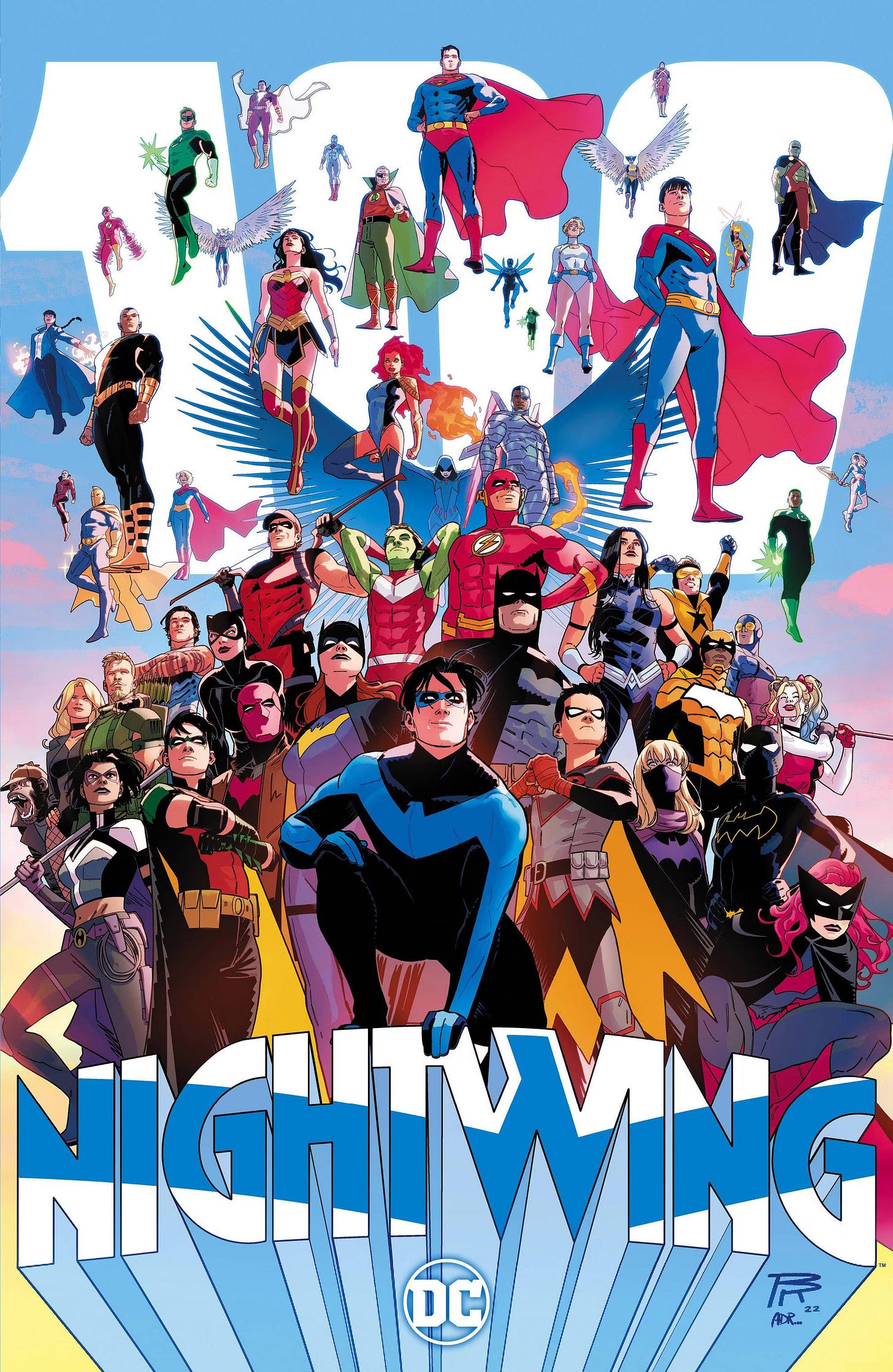
ONGOING & JUMPING ON POINT | Nightwing #100
By Tom Taylor, Bruno Redondo, Scott McDaniel, Rick Leonardi, Eddy Barrows, Javier Fernandez, Mikel Janín, Karl Story, Eber Ferreira, Caio Filipe, Joe Prado, Adriano Lucas & Web Abbott w/ editorial support by Jessica Berbey, Jessica Chen & Ben Abernathy.
I wanted to talk about my magic theory as a lead into this, because there is absolute, top level magic happening in this book. Some of this comes from meticulous preparation, and some of this comes from various creators and editors utilizing the power of the perpetual second act for good.
The preparation end started back with Tom Taylor and Bruno Redondo’s arrival on Nightwing, which saw Dick Grayson inherit billions from a sadly deceased Alfred. Identifying Dick as a truly different character than Bruce, one that was deeply empathetic and helpful instead of driven by vengeance, the creators had him use the money to try and pull Blüdhaven from away its existence as “worse Gotham”. Dick started programs and built safety nets, all while dealing with the superpowered end of things as Nightwing. The rich of the city, who required the status quo to be maintained for their way of life to continue, pushed back against this heavily by targeting Dick Grayson for assassination.
The run sped along from there, becoming a heightened version of the struggle we’re seeing out in the world today, with the rich being that extra kind of comic book evil, instead of the “regular” sociopathic evil that we have in our world. Nightwing became a book about kindness over comfort with a different kind of billionaire at the center, one that couldn’t just sit around without truly doing the most he could do to help even his community.
Eventually, this run ran parallel to the Joshua Williamson and Daniel Sampere driven Dark Crisis (on Infinite Earths), a story born from the darkest spaces of DC continuity.2 Mining DC’s rich history, a story emerged about letting darkness overtake your thoughts and action. Submitting to the grind of it all was the enemy, and it was infecting everyone. The darkness itself was revealed to be nothing but a force with no purpose - just something that could crawl into your brain and make you a force of internal and external destruction.
That particular story kicked off with “the death of the Justice League”, something that the perpetual second act of these comics would not be able to abide by for any length of time. Even though Batman, Superman, Wonder Woman and the rest were “dead”, their books came out without falter, because of course. The nature of these comics means that “death” can never be the point, but a plot.3 Through the rest of the story, these deaths were used as a somewhat literal engine to propel the plot line forward. Darkness was used to fuel darkness. It was a whole thing.
In the end (warning, very mild spoilers for the story in this paragraph), this darkness was defeated through an acceptance of hope and positivity. Dick Grayson was instrumental in this happening, acting almost as a counter-engine to the darkness that had been built. All of this featured the bombastic layover that an event book requires, but at it’s heart, it was a simple story about being a force for good in the world, and not just for others, but for yourself.
Which brings us to here. Nightwing #100. This book isn’t just a celebration of the current Nightwing run to date, but the new engine behind DC’s newest era. Entitled Dawn of DC, the rolling slate of new stories coming in 2023 is being built from a place of hope, and they’re using Dick Grayson, and this milestone issue as a foundation. Billed inside as the culmination of an arc, it is truly the start of something else entirely. It is a mission statement in all ways. On the surface level, it has the characters lay out what the future of the big DC superheroes looks like in a broad sense. The old ways allowed the darkness to exist, and thrive. Dick and his contemporaries were the ones who rallied enough to drive things back. That had to mean something, and it does.
On a deeper level, this is a book about being aspirational. It’s a book that rejects “rebuilding” for the idea of building better. DC’s marketing has made it no secret that part of this involves removing the Justice League as an idea for the time being. We all know that ending won’t last forever, and the characters themselves acknowledge it too. There will always be a return - but in this case, the delay calls for building. It calls for action. It calls for a different way of thinking - one that many of the folks in story tie to Dick Grayson’s character.
Outside of that, this is a book that is deeply reverent to its history. If you take a look at the artists listed above, you’ll see a who’s who of creators that are deeply tied to Dick’s journey over the years. It embraces this never-ending history, and presents us with something aspirational to look forward to while things come back around again.
This, was something special. This, was a beautiful thing. This, is how you build, and execute an event.
This, is how you perform magic.
The Pitch | A lot of folks will be interested in all the corners DC is using their Dawn of DC status quo as a means to tidy up. I’ll be putting this into the hands of any fan of superhero comics that yearns for escape. While it does acknowledge how imperfect things are, it helps show us a road map on how we can approach the dark bits that seem insurmountable. It shows us something to aspire to. It shows us what heroes really look like. Anyone looking for a hero should grab this book, and retailers should be putting it in their hands.
This trick was done once more with Mark Waid and Charles Soule, with similar skill.
Featuring a who’s who of big bass melded with “The Great Darkness” itself.
Something equally well explored in the Hickman and post-Hickman eras of the X-Men books.


Member discussion